Showing posts with label 2nd Amendment. Show all posts

Jul 1, 2016

Gunpocalypse 2016: Results Are Not Good

We have the final word on Gunpocalypse” 2016. From the original post the list expanded and contracted. 11 Bills made it through the Assembly and Senate to Governor Brown’s desk. He signed 6 into law and vetoed 5. This will try to address what will happen and how one might comply with these onerous laws. With the passage of these laws California easily jumps to the lead as being the most restrictive state in the nation concerning gun laws. It might say something that the official website of the press release of the list of signed and vetoed bills was crashed for some time. If you want a better explanation of each bill, see the original post.

The New Laws
  1. SB 880 Firearms: assault weapons.
    1. The bittersweet relationship the California gun owner had with the “bullet button” is coming to a close. The legislature sought to ban semiautomatic sporting rifles and capitalism responded with ingenuity only a few years later. The previous fix was a setup that required one to open the upper receiver to load cartridges into an internal fixed magazine. Much in the same way one would load a bolt-action Remington 700.
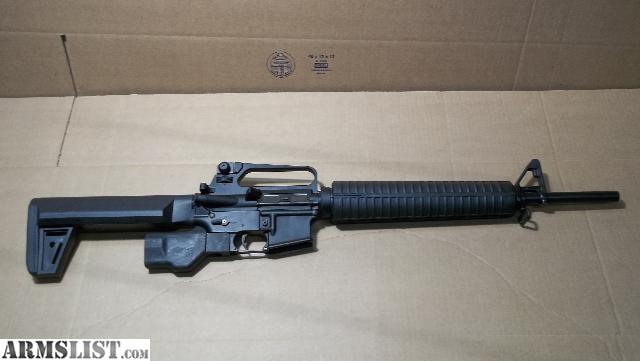
    2. Fear not, innovators have already forecasted the lack of restraint the leadership in California would exercise and created this feature which complies with the new law’s text.
    3. It might be worth noting that universal firearm registration did not go into effect until January 1, 2014. Any home-build long gun and long gun not voluntarily registered prior to 2014, California has no official record of its existence. This law will be difficult to enforce.
  2. AB-1135 Firearms: assault weapons.
    1. This law redefines “assault weapons” from “a semiautomatic centerfire rifle” to “semiautomatic rifle” with the evil features. Semiautomatic rimfire rifles are now included in the list of banned rifles.
  3. AB-156 Ammunition.
    1. Following the reappropriation of taxes and fees gun owners pay for background checks and licenses, there are now new fees which California’s legal gun owners must pay to support the enforcement of illegal firearms.
    2. I am less concerned about this law. I am confident like every other law banning interstate ammo sales since 2009, this too will be struck down in federal court because it seeks to control a power explicitly held by the Federal Government, interstate commerce. If such a law were to be permitted that would be a huge power grab away from the federal government, good luck.
  4. SB 1446  Firearms: magazine capacity.
    1. This law prohibits possession of any magazine over 10 round capacity. Because there was already a law that prohibited the sale, manufacture, and importation of such magazines since 2002, this specifically targeted the “pre-ban” standard capacity magazines.
    2. This law will be difficult to enforce.
  5. AB-1511 Firearms: lending.
    1. Firearm lending is still legal, but limited to immediate family members who must also have a Firearm Safety Certificate one can acquire after passing a test and paying $25. The certificate is valid for 5 years.
    2. Let us hope between this law and the still present 10-day waiting period does not have grave results for people in immediate harm.
  6. AB 1695 Firearms: notice to purchasers: false reports of stolen firearms.
    1. This bill makes false lost or stolen firearm reports a misdemeanor which includes a stripping of gun ownership for 10 years.
Where Do Gun Owners Go From Here?
As I mentioned, some of these laws have a legitimate chance to be struck down in the courts. If a judge places an injunction on the measure then it might not be done. 
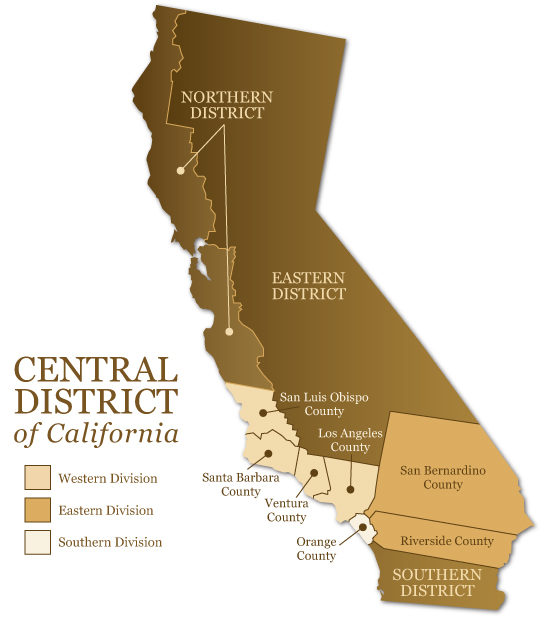
Help us Eastern and Northern Districts, you are our only hope.
 The biggest question which I think the Attorney General will have to clarify on the FAQs page, will the newly Registered Assault Weapons (RAWs) be classified differently than the original RAWs from the early 1990’s. If so those who comply with the new laws will be able to have semi-automatic centerfire rifles with all the fun accessories. The manner by which I read the text, says yes, I’m not a lawyer. It should be worth noting no RAW is transferable to any person in the state. If an owner of a RAW wishes to pass it on to family, it cannot be owned in California before the owner dies.
This is the less popular part of the message especially to the frustrated gun owners. I understand the frustration. I recognize the sabre rattling. I know the impossible nature of enforcing the most onerous laws. I also recognize the estimates of non-compliance from the first round of registration in 1990, when AR-pattern rifles were not yet mainstream. I also recognize the philosophical factors concerning unjust laws, most especially in American history MLK’s Letter from Birmingham Jail.
Despite these frustrations, if California gun owners want to proclaim that we are indeed law-abiding, then we must comply. I recognize the rough impossibility of enforcement for those who have not featured their firearms on social media. If we wish to abandon that description then we are in a much graver place as a state and nation. Even stirring the masses to “shall not be infringed” fails a history test. Per the 10th Amendment, and due to the present jurisprudence, the State has every right to ban these commonly owned firearms. I deeply disagree with the state of affairs, but I think it a much better solution to move to a less restrictive state than to knowingly violate the law. The Federalist experiment which allows for these many petri dishes known as state governments looks to be failing. I am reminded of this scene from The Patriot.

“And my principals”? I am fearful of any serious talk of rebellion or revolution. I have been to war, twice. One ought not threaten such things lightly. We glorify war in entertainment and speech. I am proud of my honorable service in the recent wars. I am also confident in peaceful resolutions. The way things look, we might be due for a Convention of the States.

Bills Still at the Legislature
  1. AB-2510 Firearms: license to carry concealed: uniform license.
  2. AB-2459 Firearms dealers: conduct of business.
  3. SB-1006 Firearm Violence Research Center
  4. SB 1407 Firearms: identifying information.

Jun 9, 2016

The 2nd Amendment Does Not Apply...


Today the 9th Circuit Court of Appeals finally delivered their opinion* to Puerta v. County of San Diego. This is the rehearing of the original case that ruled 2-1 to strike down the restrictive means of issuing concealed carry permits. Anyone familiar with the proud reputation of the 9th Circuit Court of Appeals this judgement is of no surprise. The only surprise was the delinquency of the judgement. After a short summary of laws that brought us here, I will summarize the majority decision and highlight significant arguments in the dissents.

Concealed carry permits (CCW) or Concealed Handgun Licenses (CHL) are available in all 50 states. In 42 of the 50 states the law requires any resident who is legally eligible to possess or own a firearm who applies and completes the process to get a CCW/CHL, this is known as Shall Issue. In other parts of the nation with growing frequency, states are passing Constitutional Carry which allows a person to carry a concealed handgun without a permit. The remaining 8 states practice, May Issue, that is for whatever reason, a person may be denied a concealed carry permit or in some of these states a firearm permit. New Jersey Second Amendment Society has an interesting undercover series on YouTube.

Taken from USA Carry
California is one of the eight states which are May Issue. As it stands, the issuance is based on the individual policy of each county’s sheriff. The sticking point in order to get a CCW is the “good cause” and “good moral character.” The point of this case was Yolo and San Diego counties had stringent understandings of “good cause.”
Both counties define “good cause” as requiring a particular need. San Diego County defines “good cause” as “a set of circumstances that distinguish[es] the applicant from the mainstream and causes him or her to be placed in harm’s way.” Similarly, Yolo County’s written policy requires “valid” reasons for requesting a license. Importantly, under both policies a general desire for self protection and protection of family does not constitute “good cause.” (pg. 68)

The majority opinion narrowly addresses if the 2nd Amendment applies to protect concealed carry. The vast majority of the opinion’s argument approaches this issue from a historical legal analysis that is rather thorough. I would question why the Court looked to the restrictions of serfs and colonists under the King as positive examples showing the “reasonability” of such carry restrictions. There are also 19th century case examples in which numerous localities banned concealed carry to also include bladed weapons. Within the narrow scope of the case and question, the majority does a fair shake…

Except one thing. None of the other states who are may issue have also banned unloaded and loaded open carry statewide. The primary reasons the 3-judge panel struck down the “good cause” requirement the first time was precisely because California banned open carry in populated areas. Here are some quotes from the dissents to elaborate the weakness of the majority opinion.
The majority sets up and knocks down an elaborate straw argument by answering only a narrow question—whether the Second Amendment protects a right to carry concealed firearms in public… Indeed, the majority’s lengthy historical analysis fails to appreciate that many of its cited cases either presumed a right to openly carry a firearm in public or relied on a pre-Heller interpretation of the Second Amendment. (pg. 60)

The Second Amendment guarantees “the right of the people to keep and bear Arms.” U.S. Const. amend. II. Heller held that the Second Amendment conferred an individual right to keep and bear arms for self-defense. Indeed, Heller adopted Justice Ginsburg’s definition of “carries a firearm” to mean “wear, bear, or carry... upon the person or in the clothing or in a pocket, for the purpose... of being armed and ready for offensive or defensive action in a case of conflict with another person.” (pg. 61)

Heller defined the right to bear arms as the right to be “armed and ready for offensive or defensive action in a case of conflict with another person.” (pg. 70)

The counties and California have chipped away at the Plaintiff's’ right to bear arms by enacting first a concealed weapons licensing scheme that is tantamount to a complete ban on concealed weapons, and then by enacting an open carry ban. Constitutional rights would become meaningless if states could obliterate them by enacting incrementally more burdensome restrictions while arguing that a reviewing court must evaluate each restriction by itself when determining its constitutionality. (pgs. 75-76)

The majority’s holding—that California must accommodate the right to bear arms in public through open carry—is unsupported by Supreme Court precedent and contrary to federalism principles. The Supreme Court has never dictated how states must accommodate a right to bear arms. (pg. 77, emphasis added)

However, the County Defendants and California have failed to provide sufficient evidence showing that there is a reasonable fit between the challenged laws and these two objectives… This distinction is important
because the County Defendants and California have not provided any evidence, let alone substantial evidence, specifically showing that preventing law-abiding citizens, trained in the use of firearms, from carrying concealed firearms helps increase public safety and reduces gun
Violence… There is simply no evidence in the record showing that establishing a licensing regime that allows trained law abiding citizens to carry concealed firearms in public results in an increase in gun violence. (pgs 82-83)

*This is the link of my reviewed text. If you want a blank version of the opinion here you go. The key to my highlights are yellow

Jun 4, 2016

President Obama's Town Hall and Gun Rights


Okay, in light of the tragedy at UCLA this last week the President’s Town Hall clip responding to the gun control issue has been making its rounds again. I’ll address each claim. I am not trying to shut down the conversation with a wall of text. I only hope to inform people unaware of the state of gun rights in California and in politics. I would be more than happy to address any particular point in more depth.

Democrats are not “hell bent on taking away folks guns.”
Not according to some places where Democrats speak freely. There are some bold Democrats who will propose outright confiscation. What I have yet to see are any gun control/safety advocates speak against such measures to prove they do not support confiscation. For all I know there are many “gun safety” advocates who approach their goals over time.

Gun Violence Restraining Order was passed after the Isla Vista Rampage. The original text allowed any person to make a claim against another to have their weapons confiscated. The law that passed only allowed family members to make such a claim. AB 2607 is currently on route to the governor’s desk to expand the list of people who can make the claim to include: employers/employees and teachers. Given the state of Civil Discourse in society does anyone seriously think this addition would not be abused?

There are several new gun laws also at the governor's desk to be signed that require gun owners to turn in certain types of previously legal firearms and their accessories. Here is a list of all the gun laws headed to the governor’s desk this year. It might be worth noting the only anti-gun law that didn’t make it through the CA legislature was a ban on all semiautomatic firearms.

More guns have been sold since he’s been president, ever.
This is true. This is due to the rallying cry Democrats start after every mass shooting to put forward gun control. Anytime something people want that is threatened to be banned is believed to be banned, there is a surge. Most calibers have been reasonable to find at their pre-surge prices the .22 Long Rifle rimfire cartridge has gone from about $.02/ea to $.12/ea. Yes, a 6x price per round increase, this is my conservative estimate of what one can find in bulk online sales. If we are talking regular price retail, then it is closer to $.16/ea.
He has never proposed confiscation.
Following the Umpqua killings President Obama lauded the Australian model. Australia required by law many lawful gun owners to turn in their firearms. This endorsement was not an isolated incident. Democrats have frequently lauded the policies in the UK and Australia as positive policies.

We should treat guns like cars.
The President described how seatbelt laws, airbags, DUI crackdown, road design, and the ability to study the events lead to reduced auto deaths. The President wanted to approach gun deaths like public health.
This is a common comparison. Except that every driver’s training class begins to remind us potential drivers that driving is a privilege. If one believes what the Supreme Court said in 2008, then gun ownership is a fundamental right, not a privilege. A more appropriate issue to compare public safety and gun rights would be other fundamental rights such as: speech, religion, assembly, association, unreasonable searches and seizures, self incrimination, etc. See Incorporation of the Bill of Rights for a better list.

Suspected terrorists can buy guns, compares to no fly list.
The President looks at the no fly list a an effective tool, there have been numerous problems with the administration of such a thing. The ACLU has a pretty clear position on watchlists. This at least is a better comparison to driving cars, as the right to freely move between the states is a fundamental right. Then again, this only questions the legitimacy of watchlists in general. If a person has not been charged with a crime or been adjudicated through Due Process, should a fundamental right be lost? The most telling of the President’s response. By his language, he does not think of the 2nd Amendment as an incorporated fundamental right. There is a long history with President’s disagreeing with the Court and he is fine to do so, but he ought to be forthright about such positions.

May 27, 2016

Gunpocalypse 2016

This year there are 16 anti-gun bills between the Assembly and Senate of California. So far 11 of them have passed and are waiting for the Governor’s signature or veto.  I am certain the only thing that might stop the other 5 from being sent to the governor’s desk is the redundant nature of several of these proposed bills. The remaining 5 will be voted on tomorrow. This crop of proposed laws have been coined Gunpocalypse”. There are plenty of advocacy groups who break these bills down to digestible summaries for lay audiences, in doing so they often lack the clarity of the actual effect. I’ve got all 16 bills text in open tabs, let’s do this! I am going to be nerding out on some statutory text in this blog.

  1. SB 880 Firearms: assault weapons.
    1. The AR-patterned rifle is the most popular firearm in the United States. To own one in California with the “evil features” it must be a fixed magazine rifle.
    2. This law redefines “fixed magazine” to include that the “device cannot be removed without disassembly of the firearm action.” At the same time this feature appears to meet the new definition of a fixed magazine.
    3. Any firearm that was previously a “fixed magazine” rifle would have to be registered as an assault weapon or face criminal penalties. Once a firearm is a registered assault weapon it cannot ever be transferred to another person within the state. Between the online form of registration and the fee it looks to be at least $35/person but the text does not place an upper limit on the cost to register a firearm.
    4. As far as I can find, a legal fixed magazine rifle has never been used in a criminal act. The bullet button accessory has been around close to a decade. News articles and police reports have difficulty enough reporting the accurate model of a firearm, not once has a fixed magazine rifle been mentioned in the commission of a crime. As a fixed magazine rifle, it is wholly ineffective for self defense or any activity that requires more than 10 shots.
    5. At the same time, a part of me hopes this law passes because of the lawsuits it will induce. Per Heller (2007) the “the Second Amendment extends, prima facie, to all instruments that constitute bearable arms, even those that were not in existence at the time of the founding.” The test of protected bearable arms has been all weapons in “common use.” Given the detachable magazine rifle is the most common across the nation and probably the most common in California, a law that goes further than the already present Assault Weapons ban taunts the courts to intervene.
  2. AB-1135 Firearms: assault weapons.
    1. This law redefines “assault weapons” from “a semiautomatic centerfire rifle” to “semiautomatic rifle” with the evil features.
    2. This seeks to make the favorite plinking .22lr cartridge to be legally as hazardous as larger caliber hunting calibers. What does this practically mean? The Ruger 10/22 would now be an assault weapon.  
  3. AB-1664 Firearms: assault weapons.
    1. This law is verbatim the same as SB 880 above.
    2. You might have noticed Secretary Clinton has stepped up her anti-gun game in the primaries, largely because that is the only issue she really differs from Senator Sanders on. Following her lead, Democrat leaders are scrambling to prove themselves by who is more anti-gun, thus submitting identical bills but with different names and credit for their effects.
  4. AB-2607  Firearm restraining orders.
    1. Following the Isla Vista spree murders where 3 people were stabbed to death, 3 were killed by firearms, 7 were shot, and 7 were run over with the perpetrators vehicle the Gun Violence Restraining Order (GVRO) was passed. This enabled law enforcement to confiscate one’s firearms following a request from immediate family members fear that they may be a danger to themselves or others. This was because the perpetrator passed the background checks to purchase his firearms and he also passed a “health and welfare” check by law enforcement shortly before his heinous acts.
    2. This bill adds to the list of people who can report such a concern to include: employer, coworker, mental health worker or educator. For the educator or mental health worker they must have interacted with the individual in the recent 6 months. The original GVRO text allowed for any person to issue such a report but following clear potential for abuse narrowed the text to immediate family members.
    3. Given the current climate concerning the state of civil discourse in the nation it appears to me the potential for abuse between teachers/professors and/or coworkers who disagree politically over gun rights this bill would effectively hinder any gun owner from free speech. This reminds me of that time the DHS reported that veterans, conservatives, and gun owners were potential domestic terrorists.
  5. AB-156 Ammunition.
    1. This is the background check for ammunition sales bill. It will include a tax and registration fee in order to purchase ammunition within the state. Not only would a background check have to be done for any face to face ammunition sales, if I am reading this correctly, any out-of-state ammunition transactions (online) the delivery would have to be left at an ammunition dealer for the check to go through and be picked up.
    2. Sen. De Leon has been actively trying to ban online ammo sales since 2009. His laws have passed twice, both times they were thrown out in the federal courts because state legislatures cannot make such demands of delivery service agents conducting interstate commerce. The Constitution explicitly gives Congress that exclusive right. The other ammo ban attempt was redefining any ammunition that could pierce metal to be “armor piercing” and thus illegal. The bill did not provide any technical specifications of “metal” thus included tin foil. Effectively his bill sought to ban all ammunition in the state.
    3. This doesn't mention how much of a backup to the NICS background check it will be when California exponentially increases the demand for background checks. When the system is down does that mean no one could purchase ammunition in the state?
  6. SB 1446  Firearms: magazine capacity.
    1. Ever since 2002 (really 1994 because of the Federal Assault Weapons ban), the sale, manufacture, or importation of ammunition magazines with a capacity over 10 rounds have been illegal. Those who had standard capacity magazines over 10 rounds prior to 2002, we able to maintain possession, although the types of firearms one can use in them are very limited.
      A "Featureless" rifle lacks a pistol grip, telescoping stock, flash hider, and forward grip.
    2. This law prohibits possession of the pre-ban magazines.
    3. I would like to point to the most updated assessment of the 1994 federal assault weapons ban that like the previous assessments could not associate magazine size with crime rates because the number of crimes committed with assault weapons on a national scale was so small. “Accordingly, the LCM ban has greater potential for affecting gun crime. However, it is not clear how often the ability to fire more than 10 shots without reloading (the current magazine capacity limit) affects the outcomes of gun attacks” Page 19.
  7. SB 1407 Firearms: identifying information.
    1. Ever since an infamous press conference by now Senator Pro Tem Kevin De Leon who claimed “ghost gun” rifles were short barreled machine guns he has been on the warpath to ban homemade rifles. There are a number of videos on Youtube that show how to turn a block of metal into a legally defined firearm. The technical difference, the block of metal does not have a slot for the fire control group components that make a legally defined firearm. Once the block of metal is milled out, it is a firearm according to the federal government.
    2. According to the text, following July 1, 2018 any firearm built at home must be serialized and registered. Doing so requires an $18 tax per weapon.
    3. The legal reason why firearms are serialized and can be mandated to be registered are found under the Interstate Commerce clause of the Constitution. Therefore, in theory any item not being sold or manufactured for sale, there is no legal jurisdiction to prompt such a requirement. There are no reliable estimates how many home built firearms there are in the state of California. I have not seen any publications showing a high level of criminal use of such weapons. The support or opposition to this bill goes back to the “criminals don’t follow laws” argument of the ineffectiveness of this measure to reduce crime but extending the government’s oversight on its people.
  8. AB-857 Firearms: identifying information.
    1. This is just like SB 1407 trying to steal anti-gun bill credit by making its way in the Assembly versus the Senate. It is roughly the same tactic as AB 1664.
  9. AB 1673 Firearms: unfinished frame or receiver.
    1. This redefines firearm to “a frame or receiver blank, casting, or machined body, that is designed and clearly identifiable as a component of a functional weapon, from which is expelled through a barrel, a projectile by the force of an explosion or other form of combustion.”
    2. Remember the metal frame from the above law? This law classifies that block of metal, which does not have any moving components in it as a firearm.
      Half joking but still legally true, even this literal block of metal would be classified as a firearm according to this law.
  10. SB-1006 Firearm Violence Research Center
    1. The premises this bill is based upon are:
      1. “infamous mass shootings” over the last 3 decades to include the San Bernardino terrorist attack.
      2. “In 2014, there were 2,939 firearm-related deaths in California, including 1,582 suicides, 1,230 homicides, 89 deaths by legal intervention, and 38 unintentional or undetermined deaths.”
      3. “Federal funding for firearm violence research through the Centers for Disease Control and Prevention has been virtually eliminated by Congress since 1996.”
    2. Therefore, this bill enables the “Legislature to establish a center for research into firearm-related violence” “by the University of California” for the purpose of transdisciplinary research concerning:
      1. “The nature of firearm violence, including individual and societal determinants of risk for involvement in firearm violence, whether as a victim or a perpetrator.”
      2. “The individual, community, and societal consequences of firearm violence.”
      3. “Prevention and treatment of firearm violence at the individual, community, and societal levels.”
    3. Because this bill specifically targets “firearm-related deaths” it is difficult to see a purpose of neutrality to even mask its purpose. At least they were honest enough to recognize over 50% of the firearms related deaths were suicide, nationally the average consists of about ⅔ of firearm deaths to suicide. But the bill is not interested in violence as a whole, only “firearm violence.” I am not sure if an unexpected death is less of a tragedy whether the tool used was a gun, knife, or hammer.
  11. AB-1511 Firearms: lending.
    1. Present law allows “a loan of a firearm between persons who are personally known to each other” for 30 days or less.
    2. This law narrows the list of people who can be loaned a firearm for 30 days or less to immediate family members, grandparents, grandchildren, or domestic partners. Furthermore, if a handgun is being loaned, it must be owned and registered to the person making the loan.
    3. I have known people who were legitimately threatened and were in regular contact with law enforcement because of the threats. At the time I was legally allowed to loan them a firearm for 30 days or less, which I offered. This law would prevent such a gesture, which when combined with the 10 day waiting period, might prove to be insufficient.
  12. AB-2510 Firearms: license to carry concealed: uniform license.
    1. Presently if a California resident wishes to get a concealed carry permit (CCW) they apply and are approved at the county level by the county sheriff. This has allowed many counties to issue CCWs per the conditions of the locality. This law makes the criteria for CCW issuance a state issue to be determined by the Attorney General.
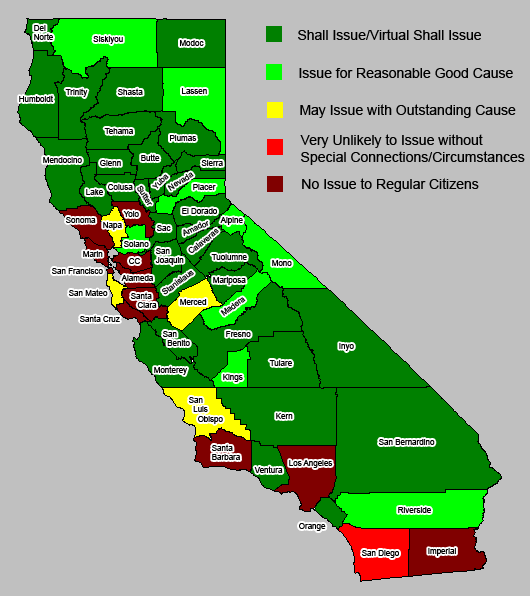
      CCW Issuance by County, 2015
    2. As you can see by the Issuance map, the more urban an area is, the less likely one is to be issued a permit. Most of the states in the nation have a policy of “shall issue” whereas if you are not prohibited from owning or purchasing a gun you will be approved. California is one of a few states who are “may issue” which the ability to acquire an CCW depends on the good graces of the sheriff. Given the electorate in California, if the AG crafts the may issue policy, almost no one will be able to get a CCW if this is signed. This is also a centralized power grab from the local jurisdictions. I would think the senior elected law enforcement officer would have the best understanding of their community’s needs more than the state elected Attorney General. At the same time, Puerta v. San Diego decision which may override this bill has been due for some time.
  13. AB 1674 Firearms: transfers.
    1. Presently there is a rationing of one firearm purchase per 30 day period in California. This applied to any firearm purchased from a Federal Firearms Dealer (FFL). Private party transfers, that is two people selling a pre-owned firearm, which is still required to go through the FFL and background check, did not have the 1 gun per 30 day limit.
    2. This law makes no exceptions. Only one firearm transfer per 30 day period.
    3. I am curious why this law was deemed necessary? There is already a 10-day waiting period for a firearm so it is not as though someone facing an imminent threat can legally acquire a firearm for self defense when needed. I can imagine a number of estate sales or transfers which family members will now have to spend years to disperse the belongings of a gun enthusiast relative. This is a measure that will limit another means of revenue for gun dealers who tend to charge significant transfer fees between Private Party Transfers.
  14. AB 1695 Firearms: notice to purchasers: false reports of stolen firearms.
    1. This bill makes false lost or stolen firearm reports a misdemeanor which includes a stripping of gun ownership for 10 years.
    2. Purchasing a gun in California also signs you up for a pamphlet of the laws “relating to firearms, gun trafficking, and safe storage” from the Attorney General.
    3. I’m not really opposed to this one. I’ve been actively following firearm legislation since 2009, in California there are new laws that are passed every year. Several have been vetoed or overturned by courts, some stay. It can be rather laborious to remain properly informed, especially for people who do not enjoy reading legal documents.
  15. SB 894 Firearms: lost or stolen: reports.
    1. This law requires a gun owner to report to law enforcement within 5 days of realizing their weapon has been stolen or face fines or more. If the weapon is recovered, subsequent report must be made within 48 hours.
    2. I find this uniquely funny and sad because following the passage of Prop 47 last year, a person who stole a firearm worth less than $950 was only guilty of a misdemeanor. Wouldn’t it be something if the criminal laws targeted criminals more than it did victims?
  16. AB-2459 Firearms dealers: conduct of business.
    1. This is only directed at Federal Firearms Licensees (FFL), aka gun dealers. It requires the licenses to correlate with a business location. It also requires dealers have color video recordings of every sale of a firearm or ammo. The dealer is also required to maintain that video archive for 3 years. The dealer is required to do ensure the recording system is working properly weekly and get annually inspected by the state. If a firearm is traced to a local shop the police must be given access to the video.
    2. This is presumably to help reduce the number of firearms straw purchases. A straw purchase is when an individual who can pass a background check purchases a firearm for someone who is not legally able to purchase or possess a firearm. The ATF does not publish how many active straw purchase investigations occur by state. Based on 2014 data, 23% of the 19,679 firearms traced by the ATF come from other states. A firearm is only traced by the ATF if it has been requested by law enforcement. In FY2015 470 firearms were reported stolen. This is prior to Prop 47, so most stolen firearms would presumably have been reported. This actually may serve to argue for SB 894.
    3. The effect of this law is two fold. Many FFLs operate small businesses from their homes. This shuts them down. Those FFLs and ammunition dealers with storefront locations will now have to record every single purchase for 3 years. Between the surveillance array necessary in the store and the archival data necessary this will greatly hinder firearm businesses across the state. Per the statute, during the recordings must be constant and continuous throughout the operating hours. Figure a business is open 8 hours a day almost everyday, so minus Christmas, New Years, Thanksgiving, 4th of July, and Memorial Day for rough estimate. That is 8640 hours of surveillance to maintain 3 years of footage. Standard definition video data rate is 1Mbit/s for 480 resolution. The data storage should then accommodate 31,104,000 MB or 31TB of data, at minimum. This setup looks to require a RAID drive, which will provide new overhead costs, although computer technicians will appreciate this law. Somewhere the gun dealer must now manage that volume of data while operating their business.
    4. This is state of reasonable business oversight in CA? Don’t forget the additional costs from the ammo permit from AB-156. How much of a price increase does this mean for ammunition? In 2010 it was common to find .22lr at $.04 or less per round, in a retail outlet one is doing well to find it for $.12/round. If ammo costs keep increasing how will gun owners reasonably be able to maintain training?

I was really tempted to break this up into a couple posts, but the only purpose for that would be to make this click bait. I cannot do such a thing. I am confident Gov. Brown will veto some of these laws, but I cannot know which ones will be vetoed and which will remain. Whatever the result, any of the more grievous laws (I tried to arrange the bills from the worst down) will be fought in the courts.